

Gut Health
Our digestive tract is the absolute foundation for vibrant wellbeing. Time and time again, I have seen that compromised gut health all too often leads to a weakened immune system, diverse digestive problems, unexplained food allergies and general malaise. This is why I prioritise gastrointestinal health and work to support its optimal function.
Gut bacteria and microbiota
Not only is 70% of our immune system found in our gut, the gut is also home to our enteric nervous system, sometimes referred to as the ‘second brain’. We are still only beginning to understand how the ‘gut-brain’ axis works, but there is a clear relationship between mental health and gut health.
What is gut microbiota? Put simply, gut microbiota refers to the microorganisms residing in the gastrointestinal tract, including bacteria, archaea, viruses, and yeast and other fungi. Gut microbiota influences depressive and anxiety-like behaviour and changing the gut bacteria with specific probiotics can change this behaviour.
Some common health conditions I often see with my clients, such as irritable bowel syndrome, digestive problems, acne, brain fog, and autoimmune diseases, are linked to gut microbiota. This is highly significant because gut health plays such an important role in metabolism and immunity.
In addition, more than 90% of serotonin – a key happiness neurotransmitter – is made in the gut. Did you know that diet can also affect this and that the more diverse healthy bacteria there is in your gut, the more likely you are to produce serotonin?
What can we do to increase our gut health?
Make sure you replenish your gut microbiome after antibiotics. Did you know prolonged exposure to antibiotics can alter our basic physiological balance and promote long-term disease? Find out what to do in my blog on replenish gut microbiome after antibiotics https://emmamaitland-carew.co.uk/how-to-replenish-gut-microbiome-after-antibiotics/
Probiotic fermented foods such as sauerkraut, kimchi, kombucha and kefir can increase healthy bacteria and they often work through the vagus nerve. When you have your probiotics, remember to eat prebiotic food because this is what probiotics feed on and proliferate from!
Prebiotic rich foods feed the trillions of live beneficial bacteria that live in your gut. They act as a fertiliser for the microbes, fuelling their growth, diversity and activity. The dietary fibre in prebiotic foods increases the bulk of the stool and helps to regulate bowel movements helping to reduce constipation. Did you know that the best prebiotic food is stewed apples?
Tips to support digestion:
- 1. Give thanks for each meal before you start!
- 2. Start the day with a hot lemon and water
- 3. Don’t drink for at least 30 minutes before your meal, and an hour after it
- 4. Put at least 20 minutes aside for eating
- 5. Find somewhere relxed to eat where you can concentrate on your meal (away from televisions, computers adn newspapers)
- 6. Chew each mouthful at least 20 times or until the food loses its texture
- 7. Sit up straight while you eat
- 8. Have a mouthful of food 10 to 15 minutes before each meal
- 9. Rinse dishes well after washing (add rinse cycle for dish washers)
- 10. Go for a short walk after your meal
Gut health and blood tests
Blood analysis can be very helpful. Using a darkfield microscope to analyse live and dried blood, we can literally see – in real time – the size, shape, ratios and movement of your red cells, white cells, platelets and plasma. Seeing the live and dried blood samples gives us vital clues towards potential degenerative and chronic health conditions enabling us to prevent them wherever possible.
Live and dried blood analysis will give important information about vitamin and mineral deficiencies, digestive imbalances and gut microbiome health, liver and kidney function (detoxification capacity), cell membrane integrity, as well as inflammation and immune health.
Using a darkfield microscope to analysis live and dried blood, we can identify many anomalies that are associated with digestive issues. For example, the integrity of your red blood cells in live blood can give an indication of your ability to properly digest and absorb protein from your diet.
Your plasma can give an indication of your ability to digest and absorb fats from diet. Primitive microorganisms can be seen moving around in your plasma indicating a gut microbiome infection, and platelet fermentation which can indicate a candida yeast infection. A white blood cell count can also indicate a gut bacteria infection.
Your dried blood can give an indication of leaky gut, poor detoxification capacity, a parasitic infection amongst many other anomalies.”
Simone’s live blood analysis
Simone is an excellent example of how live and dried blood analysis had a massive impact on improving gut health. Simone came to me presenting with many years of chronic fatigue syndrome. She was unable to exercise and was suffering with issues relating to poor digestion.
As you can see in the image below, her red blood cells are overlapping (green arrows) and there is increased fibrin in her blood (blue arrow) which is an indication of high inflammation. Her red blood look like a target (red arrows) which is an indication of an iron deficiency.
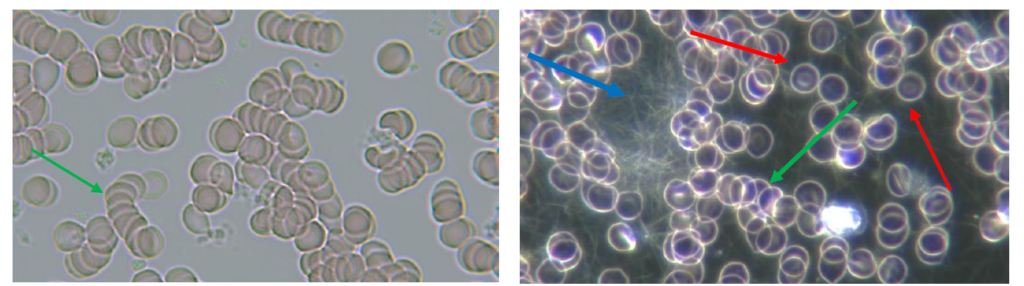
In the initial consultation, I encouraged this client to chew better and also suggested a digestive enzyme which particularly supporting stomach acid production. I recommended that she increase oily fish and turmeric in her food as well as take a fish oil. She also took a probiotic (beneficial bacteria) supplement.
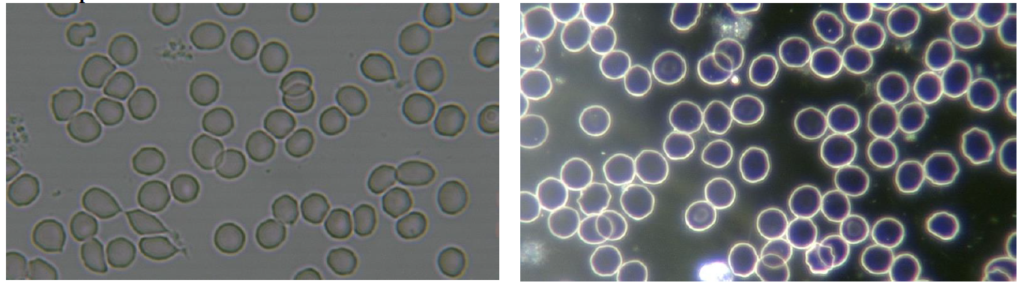
When she can back for her follow-up appointment, she describes having more constant energy throughout the day and was starting to exercise again (mainly swimming). She had taken gluten-out of her diet and her digestion had significantly improved. You can see a really positive difference in her live blood. You can find out more about live and dried blood analysis and how to book these tests in your consultations.
Other tests for gut health
A stool analysis can also be very helpful at diving deeper into an individual’s gut microbiome giving a detailed report of their beneficial and pathogenic bacteria, fungi, yeasts and parasites as well as gut immunity, inflammation and digestive markers.
According to research, 60-84% of all IBS is considered to be SIBO. It is only beginning to be understood, and is a complex condition which requires proper assessment and treatment. It is associated with many different symptoms but the main ones include:
- bloating (belching and flatulence),
- digestive pain,
- diarrhoea and/or constipation,
- food intolerances,
- acid reflux and nausea,
- fatigue, anxiety and brain fog,
- headaches.
If you are experiencing any of the above symptoms, it can worth finding out whether the underlying cause is Small Intestinal Bacterial Overgrowth (SIBO). This can often be triggered by food poisoning, stress, antibiotics, and tummy bugs. SIBO damages the walls of the small intestine leading to malabsorption and increased food sensitivities. A SIBO test is available as a breath test that measures hydrogen and methane gases produced by bacteria in the small intestine. Symptoms associated with a SIBO infection include bloating (belching and flatulence), pain, and diarrhoea or constipation (or both).
With every blessing,
Emma
Emma Maitland-Carew – Registered Nutritional Therapist
Dip.ION, mBANT, CHNC Registered Practitioner,
Metabolic Balance® Coach, HeartMath Coach, Accredited Wellbeing Coach.


