
Foraging: Finding nature’s bounty
There is a beautiful poem by John Keats which I think you will be familiar with and which, like me, you probably think about at this time of year. The first stanza is especially evocative:
Season of mists and mellow fruitfulness,
Close bosom-friend of the maturing sun;
Conspiring with him how to load and bless
With fruit the vines that round the thatch-eves run;
To bend with apples the moss’d cottage-trees,
And fill all fruit with ripeness to the core;
To swell the gourd, and plump the hazel shells
With a sweet kernel; to set budding more,
And still more, later flowers for the bees,
Until they think warm days will never cease,
For Summer has o’er-brimm’d their clammy cells.
As I take walks with my puppy, Pickle, I am aware of the fruitfulness of the land around me and of how much food there is if we look for it. I find that now I am aware of rosehips or bullace, the more I seem to see them hanging from every hedgerow I walk past.

With Autumn setting in, you can still find some blackberries and elderberries in the hedgerow, but traditionally the last day to pick these is 10 October. After that there is the danger of mould.
Other berries are great for making syrups or adding to alcoholic drinks such as gin. If you want a fancy gin, look out for sloes (blue-black berries of blackthorn). Sloe gin is the sweet liqueur that’s traditional at Christmas and throughout the winter. Here’s an easy recipe for you to make your own sloe gin for a gin and tonic or to use in cocktails from the Woodland Trust or you can watch this video.
As you are looking for sloe berries, you might find you are collecting bullaces. These look almost identical to sloes, but they are slightly larger and are found growing in clusters rather than spread out like sloes. You can watch this informative video to learn more. If you find you have enough bullaces, you might like to try this lovely plum and ginger chutney.
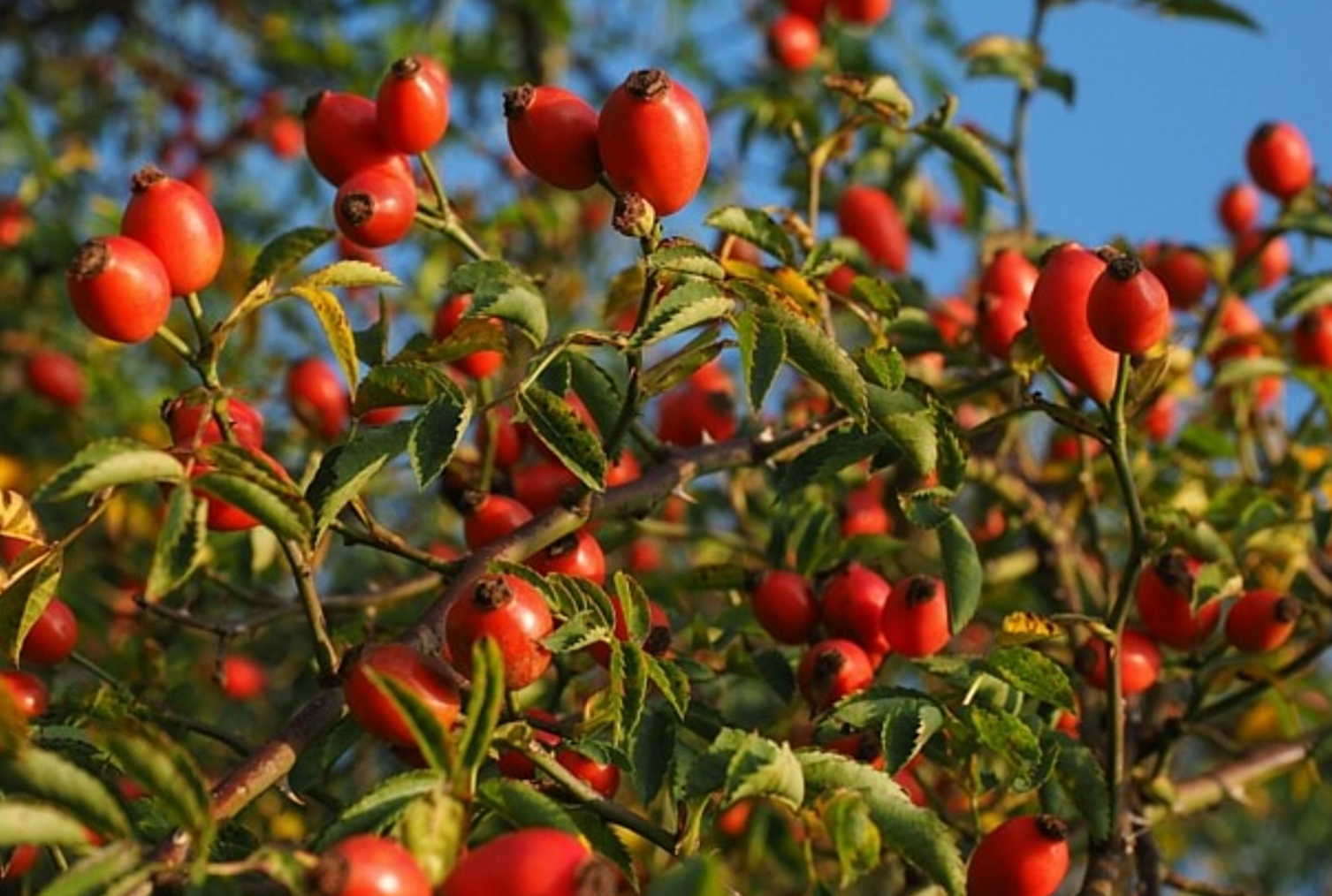
If you want a fabulously healthy syrup look out for rosehips (striking red hips from the common dog rose). Rosehips are produced by all sorts of rose bushes (Rosa canina or Rosa rugosa) and you will see them growing in woods, scrub and hedges. The rosehips are bright, oval shaped hips and you can’t miss the flash of red as you walk in the countryside. They ripen at this time, but are best picked after the first frost as they will be slightly sweeter.
During World War II, scientists realised that rosehips have more Vitamin C than oranges, as well as Vitamin A and E. Since they were readily available, everyone was advised to pick them and make syrup for themselves and their families. The Ministry of Food recommended a daily dose of rosehip syrup for all children and a national week for the collection of rosehips was established when scouts and children’s groups would harvest them from the hedgerows in late September. They collected 200 tons of rosehips in 1941 and this made 600,000 bottles of syrup! You might like to try this rosehip syrup from the Woodland Trust and also watch this video to learn more.
We can still see plenty of apples and if you have the time, there are plenty of crab apples around which make a great drink. Crab apples ripen late in September and October and although they are too tart to eat off the tree, you can make delicious fermented drink. As you know, I am a fan of fermentation, that age-old process that increases the nutrients of the foods that are fermented. You might like to try this fermented crab apple sauce or you can try this crab apple jelly from the National Trust.
As you walk, you may stumble across hazelnuts, which were introduced by the Romans and which you will be familiar with, but it is also possible to eat ripe acorns and beech nuts, after you scrape back their spiky brown cases to reveal the triangular nut.
Finally, if you happen to see any of the last calendula flowers before they die out, you might to collect them as well. These beautiful yellow and orange flowers make amazing skin care products. A cold infusion in oil will keep your skin hydrated and healthy all through winter! Calandula oil is very easy to make. Combine calendula flowers and petals in a sterile glass jar. Close the lid and shake to combine. Set it on a windowsill or other warm spot and leave it for 4-6 weeks. Strain the oil and combine with coconut oil so that it thickens and there you have it!
In the colder months, I like to make pine needle tea. Did you know pine needles are also rich in Vitamin C? Some people even think they can prevent blood clots, protect DNA and RNA, improve circulation, and regulate blood pressure. And they are available all through the winter. Over hundreds of years white pine tea was known to be a way to prevent scurvy in the winter and to keep people healthy until spring. You can buy pine needles from the Kent and Surrey Tea and Coffee Company or you can just go foraging and pick some yourself! Here is a lovely little video from a Swedish lover of pine needle & chaga tea which she calls ‘Forest Tea’.
Remember, make sure you have correctly identified what you have foraged so you don’t eat anything that may cause adverse effects. We are fortunate in living in a country with very few poisonous plants or creatures, but the internet is a fantastic source of information to correctly identify what you have foraged. Please also be careful with what you eat while foraging if you are pregnant.
If you would like more inspiration to do your own foraging, you can see the Woodland Trust’s Guide to Foraging or you can search out a local foraging group in your local neighbourhood.
Every blessing,
Emma
Emma Maitland-Carew – Registered Nutritional Therapist
Dip.ION, mBANT, CHNC Registered Practitioner,
Metabolic Balance® Coach, HeartMath Coach.


