Vitamin B12 – a vital vitamin
A story published in the Daily Express caught my eye earlier this month. It was the story of a woman called Sara who had been a vegetarian for more than a decade and developed severe health problems as a result of not including proper nutrient supplements in her diet. The missing complex essential vitamin that caused life-changing problems for Sara was Vitamin B12. But the story gets worse! On top of the debilitating symptoms of vitamin deficiency, her doctors were unable to identify the cause of her problems and misdiagnosed her with bipolar and she was sectioned after a psychotic episode.
This story caught my eye because many of my clients come to me with problems relating to vitamin deficiencies and many of them can have quite severe symptoms that build up over many years. Sara’s story – detailed in the Daily Express report here – is a very stark reminder of the importance of essential vitamins in our daily diet.
This is especially true of restricted diets or diets that cut out meat products completely. Many of my clients are vegetarians or vegans who do not properly understand the importance of B12 or that they need to take extra supplement if they cut out meat from their diet. If you are interested in reading more, you can see my earlier blog titled ‘Paleo or Vegan’ here.
What is Vitamin B12?
Vitamin B12 (cobalamin) is an essential, complex vitamin that is necessary for good health and day-to-day living. B12 is found naturally in animal products such as meat, poultry, fish, dairy and eggs. It is such an important vitamin that without it the fatty tissue that surrounds your nerves (myeline) becomes damaged and causes damage to the brain, the spinal cord, peripheral nerves and eyes.
It can also result in progressive neurological disorders that result in psychiatric conditions such as the ones experienced by Sara in the story above. In fact, Sara was very fortunate that her B12 deficiency was finally recognised, because it can be a life-threatening deficiency if left untreated.
Some of the other symptoms include: depression, headaches, paranoia, irritability, mood swings, mania, psychosis, tinnitus, glossitis (an inflamed tongue), premature greying, chronic fatigue, heavy periods, weight loss, visual disturbance.
Vitamin B12 and Live Blood Analysis
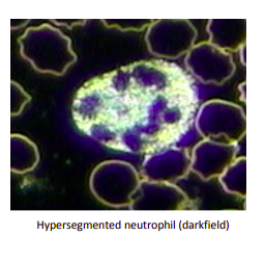
As you know, I do a lot of live blood analysis to assess the health of red blood cells, white blood cells and platelets, and also the contents of the plasma. I can immediately see if my clients have a B12 deficiency because there will be differences in the shape and size of the red blood cells, and also in the white blood cells in cases of extreme deficiency. Abnormally large red blood cells can be seen in live blood samples to indicate a B12 deficiency. I also look for ovalocytes, microcytes and hypersegmented neutrophils. The live blood analysis allows me to screen for B12 deficiences and also allows my clients to view their own blood and see the difference that lifestyle and dietary choices can make. You can find out more about live blood analysis from some of my earlier blogs here.
What can we do if we have a B12 deficiency?
Vitamin B12 injections are the most efficient and effective treatment with six injections over two weeks. While oral supplements are available, they are generally not as effective, as pointed out in this article in the British Medical Journal.[1] According to national NICE guidelines, if you have neurological symptoms then your doctor must treat you with loading dose frequency until symptoms stop or start improving. It is important to note that there is no danger with using high doses of B12 and it has been safely used for more than fifty years.[2]
In fact, in the 1950s high doses of B12 were shown to help children with neuroblastoma by making the tumour disappear or shrink, thereby increasing their chances of survival.[3] And in Japan more recently daily injections increased the life expectancy of patients with with the incurable neurodegenerative disease ALS (Lou Gehrig’s disease).[4]
It is important to eat meat and meat-based food to maintain adequate levels of B12. Good sources of vitamin B12 include meat, salmon and cod, milk and other dairy products, eggs.[5] Interestingly, many doctors realised in 1929 that people who ate a pound of liver a day did not die from certain diseases and scientists today have identified that Vitamin B12 was the substance in the liver that was responsible for this!
If you are vegetarian or vegan it is vital to supplement with B12. Nutritional yeast will help with that, as well as other yeast extracts such as Marmite.
There are a few other deficiencies which can exacerbate or mask B12 deficiencies, including folate and iron deficiency. I arrange many deficiency profiling for my clients so please do talk to me about this in your next consultation. I also test for hypo-thyroidism, hyper-thyroidism, coeliac disease and pyroluria as these often have similar symptoms, and are known to co-exist with B12 deficiency.
It is also wise to take a good vitamin B complex in addition to your B12 injection as all B vitamins need each other to work properly. Also, Vitamin B12 and folate need each so it is important to test and supplement for this and to keep an eye on your potassium and magnesium. Potassium rich foods are important while trying to increase vitamin B12 and magnesium is one of the most important minerals in the body!
What should we do if we suspect a misdiagnosis?
As Sara’s story shows, not many people know of the neurological and psychological impact of B12 deficiency, including many doctors. Her story shows how important vitamins are to our overall health. Her story also shows how a lack of knowledge can have a big impact on our physical and mental health and wellbeing if left untreated over time.
The other important thing we can learn from her story is that vitamin deficiencies can often be misdiagnosed by doctors. Sara’s doctor was unaware of the psychological and neurological symptoms relating to B12 deficiency – even though they did note her B12 deficiency. This misdiagnosis led her down the wrong path towards potent anti-pychotic drugs and at one point she was even sectioned.
As you know, anti-pyschotic drugs are very powerful pharmaceutical products that carry with them a whole host of other toxic side-effects (many of which will then require other powerful drugs to mitigate those side-effects). I would always recommend seeking out second and third opinions from other doctors before taking strong drugs and I would also recommend consulting nutritional therapists who are sometimes more aware of the significance of essential complex vitamins such as B12.
B12 deficiencies can also be misdiagnosed as dementia, vertigo, autism, ADHD, fibromyalgia, Parkinson’s disease, postnatal depression, schizophrenia and neuropathy.
There is a range of quality information available at Home – B12 Deficiency including other stories, advice and guidance, support when working with your doctor and other important information.
With every blessing,
Emma
Emma Maitland-Carew – Registered Nutritional Therapist
Dip.ION, mBANT, CHNC Registered Practitioner,
Metabolic Balance® Coach, HeartMath Coach, Accredited Wellbeing Coach.
[1] ‘Vitamin B12 deficiency’, BMJ 2014;349:g5226
[2] See Treatment with high dose vitamin B12 been shown to be safe (stichtingb12tekort.nl)
[3] Neuroblastoma: an evaluation of its natural history and the effects of therapy, with particular reference to treatment by massive doses of vitamin B12. Bodian M. Arch Dis Child 1963;38(202):606–19
[4] Clinical trials of ultra-high-dose methylcobalamin in ALS. Izumi Y, Kaji R. Brain Nerve 2007;59(10):1141-47
[5] You can see information from the NHS here https://www.nhs.uk/conditions/vitamin-b12-or-folate-deficiency-anaemia/treatment/